Paul Gooch’s Workbench: Scratching Itches, Giving Over, & Getting There
I heard about Paul Gooch long before I met him. When I was a child, my mom occasionally told stories about a few of her undergraduate professors. One she described as “the man in a green suit.” My mom had majored in History, but she had taken an Intro to Philosophy course with a green-suited philosopher who talked about Plato and Socrates.
Years later, when I was an undergraduate, I caught the philosophy bug, mainly by reading historical works, but I was slow to figure out my major. In a literature course, a professor encouraged me to look up Paul Gooch over in the Philosophy Department. Soon enough I had completed courses with him on Plato’s moral psychology and another on the philosophy of religion. At some point along the way, I learned that Hesperus is Phosphorus—my teacher was the man in a green suit.
Paul Gooch is an emeritus professor of philosophy at the University of Toronto where he has taught since he was hired as a Lecturer in philosophy in 1967, before he had written a word on his thesis, then promoted to Assistant Professor in 1970. He completed his B.A. at Bishop’s University and Ph.D. at the University of Toronto. His writing focuses on the history of ancient philosophy, especially Plato, and issues in the philosophy of religion, ethics, and higher education. Gooch has served at the University of Toronto in many administrative roles, including Vice-Provost, Vice-Dean and acting dean of the School of Graduate Studies, and chair of the Division of Humanities at the University of Toronto’s Scarborough campus. From 2001 until 2015, he was the President of Victoria University—an institution within the University of Toronto that comprises an undergraduate college, Victoria College, and a theological seminary, Emmanuel College. Gooch continues to teach at Victoria College in Vic One, a first-year undergraduate experience program.
After my undergraduate years, I studied and then taught in different parts of the United States, and I’ve stayed in touch with Paul. Being an expatriate has forced me to try to make sense of two worlds—one where I grew up, another where I’ve tried to make a career. What do I take from my origins into the place where I work? As a Canadian teaching and writing about philosophy at a distance from home, I’ve occasionally wondered: What is Canadian philosophy?
In Paul’s activities, I glimpse Canadian philosophy. Perhaps you need to know him to grasp what that amounts to, but let me at least try to explain by sharing a couple of stories.
Around 20 years ago, Paul created a forum on campus for discussions between students from different faith traditions. The students—Muslim, Jewish, and Christian—would meet for dinner to discuss a religious text from one tradition, led by three graduate students from those traditions. At some point, the Muslim graduate student asked the Christian graduate student whether Emmanuel College could offer continuing education courses for Muslim leaders. Paul had just hired a new Principal for Emmanuel College, Mark Toulouse, who was keen to develop some interfaith programs. At Mark’s initiative, they worked with members of the Canadian Muslim community to raise support and interest. The college began to offer some courses in Islamic studies, but eventually it became clear that a degree program was needed—without a master’s degree, Muslims couldn’t become chaplains in hospitals, prisons, or the military. And so Emmanuel College created a Muslim stream within its Master’s degree program in Pastoral Studies, with all of the students taking the same courses in pastoral counselling, but with separate courses focusing on texts and history from the different traditions. Emmanuel’s innovation was the first time the Toronto School of Theology, an ecumenical consortium of divinity schools, included courses for training Islamic leaders. It was also the first such program in Canada.
A second story requires a bit of background. Long before Paul’s birth and long before Canada even existed, a 300-pound iron meteorite fell to earth and landed in what is now east-central Alberta, near the current-day town of Hardisty. The meteorite was discovered by Indigenous people who called it Manitou Asinîy—the Creator Stone. Manitou Stone came to be a gathering place for tribes. One author writes of the understanding of the region’s Indigenous people: “[Manitou] placed the stone on a hill near the Battle River at Piwapiskoo, or Iron Creek, after the great flood. The elders said it had the power to protect the people of the Plains and the buffalo herds that sustained them… The stone existed to remind the Cree, the Nakoda [Stoneys] and the Blackfoot of the presence of manito, or spirit, in their lives.”
But then in 1866 Manitou Stone was stolen by a Methodist missionary from Ontario. He moved it to his mission, 200 kilometers north in Pakan, Alberta. Historians don’t agree about the missionary’s motives for stealing the stone—perhaps, seeing how important Indigenous people believed the stone was, he believed it would draw people to his mission in Pakan, or perhaps he regarded the stone as an idol that would undermine efforts to convert the region’s people.
When Indigenous spiritual leaders learned that Manitou Stone had been stolen, they prophesied that war, famine, and plague would destroy their people.
In a few short years, the prognostications would come true. War between the Blackfoot and the Cree broke out after the peaceful Cree chief Maskepetoon was killed and brutally dismembered in 1869. Dwindling buffalo herds left little food for groups that had hunted on the Plains for generations. Smallpox swept through the region in 1870, killing several thousand.
Eventually, Manitou Stone was packed up and sent eastward to Victoria College in Cobourg, Ontario, and then westward to Toronto in 1892, after the Methodist college joined the University of Toronto. For some years, Manitou Stone was kept at Victoria College; apparently, one initiation challenge for students was to lift it up and stagger around with it. In 1957, the stone was loaned to the Royal Ontario Museum where it was put on display. Then in 1972 the government of Alberta requested that Manitou Stone be given on a long-term loan to its provincial museum. Victoria College sent it westward, though retained the legal title.
Through all of these years, Manitou Stone was not forgotten by the Indigenous people of the prairies. They wanted it back. When Paul became president of Victoria University in 2001, one of his first acts was finding a way to return Manitou Stone to its people. After he drew up a plan with a curator at the Royal Alberta Museum, Paul asked his Board to approve the following motion:
THAT Victoria University cede its interests in the meteorite known as the Iron Creek meteorite or Manitou Stone to the Provincial Museum of Alberta, under the condition that the Museum undertake the process of consultation with interested First Nations peoples…
Years later, the process of repatriating the stone to Indigenous groups has made significant progress. In 2023, a non-profit organization dedicated to the return of the stone was launched. And on 13 July 2026 that organization signed a memorandum of understanding with Parks Canada that will eventually lead to the creation of an interpretive centre as a permanent home for the stone in Elk Island National Park, just outside of Edmonton, Alberta.
I said earlier that I glimpse Canadian philosophy in Paul’s work. But is there some idea behind Canada about which there could be a philosophy? I think so.
Canada at its Confederation in 1867 involved a group of people who didn’t like each other very much but knew that they did not want to be Americans. Their acceptance of deep fractures between French and English, Catholic and Protestant were part of the origin of the country and its distinctive political life. By design, the country was a bicultural experiment. But the experiment had serious, even tragic defects. Canada’s origins meant devastation for First Nations communities. Women’s suffrage moved slowly, with no women permitted to vote until the First World War, and non-white women waiting far longer for the vote. During the Second World War, most Japanese Canadians were sent to internment camps and held there until 1949. There are many other examples.
Canada is an experiment that has worked out well for some but certainly not for all. Paul Gooch is a philosopher committed to trying to improve that experiment. And in this motivation, it seems to me, Paul represents a traditional strand of Canadian philosophy going back to the nineteenth century. One idea from the tradition is that making sense of one’s identity and moral obligations call for understanding one’s community. A commentator concerned with that tradition, in a book from 1984 titled The Idea of Canada and the Crisis of Community, put the idea memorably: “I would not know who I was if I were alone in the universe.” Another Canadian philosopher noted that earlier contributors to that tradition, from John Watson to George Grant, “passed this communitarian ethos to their students, who went on to become civil servants, clergy, and teachers, and to embed those values in Canada’s government, churches, and the minds of their students.”
Paul is committed to the idea that higher education is essential for improving the Canadian experiment. These days, he’s writing a short book that locates the university in the fabric of Canadian society, along with the press and courts. The university is, he thinks, an institution with fundamental freedoms and rights, and also an obligation to serve. Paul’s work, as a teacher and writer, reflects a commitment to the possibility of a community where diverse people disagree productively, engage with mutual respect, and understand each other well enough to find to find some way, always against the odds, to live together.
Tell me a bit about your writing process.
I think of writing as scratching an itch.
Which reminds me of a story a retired English don at Cambridge, Hugh Sykes Davies, told me one night at the wine circle at St. John’s College. He said that when he was an undergraduate he decided to sit in on some of Wittgenstein’s lectures, but he had no idea what Wittgenstein was on about. So he stopped attending. One day he saw Wittgenstein coming up Trinity Street on the other side of the road. He crossed over and stopped Sykes Davies, noting that he was no longer coming to his lectures. “No, sir,” he replied. “That is alright, Mr. Sykes Davies,” Wittgenstein replied. “I specialize in curing a certain kind of stomach ache. I don’t think you have that ache.”
I have itches rather than aches. I try to scratch them, but I’m not always sure I can reach them. Sometimes I’m sure I make them worse.
What is the difference between a philosophical itch and ache? Has a poorly scratched itch ever led you to feel a little achy?
Good distinction—an itch is a surface irritation that can often be dealt with by scratching or a little cream or ointment. An ache is deeper, in the muscles or bones, sometimes cured by rest but sometimes the symptom of a more serious health problem.
I suppose I chose itching rather than aching so as to make Wittgenstein’s point without his analogy. Though I don’t want to stretch the analogy too far, in either condition you know that something isn’t quite right and you want to do something about it. It’s not mere curiosity—you’re dissatisfied with some belief and need to deal with it. The power of the analogies is that it’s about one’s own epistemic state, not the beliefs of other people. And I like ‘itching’ because sometimes it’s difficult to reach the itch and I need you to scratch my back.
Don’t let Wittgenstein scratch your itch with his poker. I don’t think I’ve ever asked you this: Why did you decide to major in philosophy as an undergraduate?
I fell into philosophy without intending to permit it to capture me. My ambition was to teach high school—French and Latin, because they were my best subjects in high school. When the University of Toronto and Bishop’s University both accepted my application, I went to Bishop’s in Lennoxville, Quebec, to get away from home. I had one elective to choose: psychology or philosophy. Had I gone to U of T or taken psychology, I would have eluded capture.
It was my philosophy professor who roped me in. He knew the background of someone like me, from a religiously conservative family, and raised questions I realized I’d been thinking about. So I came to philosophy in an Augustinian way, fides quaerens intellectum (faith seeking understanding), though I couldn’t have told you that at the time.
Growing up in a religiously conservative home, were you exposed to philosophy?
Not directly. But my father was always on the left side of conservatism, so to speak. He encouraged independent thinking. When I went to university he sent me a letter in which he said that he hoped he’d brought me up to realize that just because someone had degree letters after their name didn’t mean that I should just accept what they said. That could sound like an anti-intellectual stance, but it wasn’t.
I brushed up against philosophical arguments in a Sunday School class when I was about 12 or 13, where the teacher went through standard arguments for the existence of God. My early reading was in fiction—I devoured fairy tales and romance, and read Don Quixote in fifth grade—but by grade 12 I was writing a history essay against French deism, without actually reading anything other than the history textbook.
Tell me about the questions you had been thinking about before taking that first philosophy class at Bishop’s.
The questions were about faith and reason: I was puzzled about classic arguments for God’s existence and the problem of evil. But I was also seized with issues of the interpretation of texts, as I found some ways of reading scripture unsatisfactory. In fact, in my final year I joined the Biology Club at Bishop’s not because I was studying the subject, but in order to present a paper on evolution and religion. I wrote a long piece with a fellow student arguing that the language of the Genesis creation account was poetic, and that poetry can disclose important truths beyond science.
Who did you study with at Bishop’s?
I learned philosophy from my professor, Marion Frye. She taught ancient philosophy, so my introduction to Plato was from her lectures. Later in her career she became president of University of King’s College at Dalhousie, and then to Trent University.
When did you begin to think about grad school in philosophy?
At the end of my first year of undergraduate study, Bishop’s told me that they couldn’t offer upper level Latin courses, so I switched to Philosophy and French. And I began to think of graduate school. Theology was my aim, but I thought that a master’s in philosophy would be good preparation. By then I was interested in the history of philosophy, and the Woodrow Wilson Fellowship advisors suggested that the two best places for me to take my scholarship were Yale and Toronto. I came back to Toronto where I had grown up.
What was the graduate program at U of T like in the ’60s?
Since I didn’t have a specialist undergraduate degree in philosophy, I was admitted to a two-year M.A. in which I took some upper level undergraduate courses. That meant I didn’t immediately meet other graduate students. So I went to courses—except for the day John F. Kennedy was shot: when I arrived in class, having learned the news in a corner store just moments before, the instructor sent us home. I also neglected to take up the offer of Robertson Davies to become a junior fellow at the new Massey College; rumour was that he would post a topic of conversation for high table dinners, and I didn’t want to be examined on subjects I didn’t understand. I have paid for my early rejection of the offer: I’ve been a senior fellow of Massey College for many decades and am now on the Board.
I spent one year at Massey College and let me tell you: high table dinners were awful even after the Davies era. Somewhere there’s a photograph of me and my friend sitting at a dinner with our heads hanging down, the two of us looking glum, waiting for everything to end. We’re still waiting. So which philosophers did you work with during the M.A.?
Philosophy at U of T had some excellent faculty. David Savan was a fine thinker and dedicated teacher, for instance, and I had a small seminar with him. I remember David Gauthier bringing a newly published copy of The Logic of Leviathan in 1969 to class for our approbation. I took an ethics course with him, extra to the requirements. I wrote a paper on the two meanings of ‘desirable’ as the object of desire and as worthy of desire. Though I had to drop the course because of workload, he still gave me a decent grade for it.
When I moved to the Ph.D. program, it required not only course work but passing two three-hour comprehensive exams plus an oral defence. Although I succeeded at research and essay writing, my focus on texts and interpretation wasn’t suited to these exams, and I had to do them over again.
Thinking that I’d benefit from the experience of teaching, the department assigned me a section of PHL 100, a general introduction for non-specialists. Marcus Long, a popular and provocative professor, supervised the various sections and recommended his textbook, The Spirit of Philosophy. After a few classes I realized that the students knew little of the philosophers Long discussed, and I wasn’t about to give them a course in the history of philosophy.
What did you do?
I ditched Long’s book and ordered Richard Taylor’s Metaphysics. That way the students encountered arguments about topics they could relate to, and with my comments on Taylor they saw how philosophizing is done.1
You taught Taylor’s book just a few years after it first appeared in 1963. The book is a classic example of “midcentury modern” style in American philosophy, I think. It also includes some philosophical cartoons, illustrating different views on the mind-body problem, drawn by Taylor’s friend Roderick Chisholm. Do you remember how you first heard about the book?
I’m not sure how I came across it, but I just now looked through my bookcases and found it—and its second and third edition. There’s a fourth edition too, I believe. Taylor’s topics are great for first-year students, and his style is eminently readable. I found it pedagogically useful to work through his arguments with their non-dogmatic conclusions.
The book is heavy on non-dogmatism. Taylor hammers on the traditional idea that philosophy is the search for wisdom, but we can’t expect to arrive at clear or certain conclusions. Here’s a passage from the first edition:
Let the reader be warned… that whenever he hears a philosopher proclaim any metaphysical opinion with great confidence, or hears him assert that something in metaphysics is obvious, or that some metaphysical problem turns only on confusions of concepts or upon the meaning of words, then he can be quite sure that this man is still infinitely far from philosophical understanding. His views appear to him devoid of difficulties only because he stoutly refuses to see difficulties.2
Did you ever encounter Taylor?
No, but there’s one Taylor anecdote I know, from a friend who was on the same doctoral exam with him at the University of Rochester.
Taylor, who had brought his large dog to the thesis defence, was one of the examiners. The candidate struggled to defend himself but not very successfully. When he was asked to leave the room while the committee deliberated, Taylor’s dog jumped up and grabbed him by the leg, though the dog didn’t actually hurt him. The chair asked each committee member to comment on the performance, and when Taylor’s turn came, he simply said, “The dog is never wrong.”3
Taylor’s opinion was expressed with “great confidence,” but it was not a metaphysical opinion. Rather, it was an opinion about a knower he trusted without claiming to know himself what the knower knew. That’s an attitude of epistemological humility that more philosophers should cultivate—though I don’t recommend trust in just any knowledge-claimer, two- or four-legged. It’s hard to get a substantive philosophical claim that is impervious to revision.
Do you recall much about the grad classes you took?
The classes were fairly large and mainly consisted of lectures rather than seminar discussions. The most memorable of these was a Kant course, in which the professor read us his manuscript for an hour; then after a short break he read for another thirty or forty minutes. He asked if there were questions and, on the occasions when someone did ask one, he would return to that section of his manuscript and read it out again. The assignment for the course was to summarize the Critique of Pure Reason, half of it each term. I got a B- on my first half, so I tried harder for the second term. Got a B that time, with only three little x’s throughout my sixty-odd pages.
That’s a memorable seminar. Did you have a sense of the emergence of so-called analytic philosophy at the time and how it contrasted with other approaches?
My courses with Thomas Goudge on early-twentieth-century British analytic philosophy, and with Don Evans on analytic philosophy of religion, were much better. Evans was a rising star, with a book on the language of self-involvement—he had studied with J. L. Austin at Oxford. I wrote my M.A. thesis for Evans on William Temple’s idea of revelation. But it was David Gallop and Plato that engaged me for my doctoral work. Also an Oxonian, Gallop read Plato for his arguments.
Toronto at that time had one of the few North American philosophy departments that took the history of philosophy seriously. In large part, that was because of the department’s complicated relationship with affiliated institutions—the colleges, especially St. Michael’s where Catholic philosophers taught a series of philosophy courses with their own designation, and the Pontifical Institute of Mediaeval Studies where Étienne Gilson had taught.
Of the other non-analytic philosophers, Emil Fackenheim was the most prominent. I sat in on a lecture on Hegel but found that not to my philosophical taste. When I later taught philosophy of religion, however, I would sometimes use Fackenheim’s God’s Presence in History, and I regretted not having got to know him better.
Let me backtrack a little. You had to take your comprehensive exams for a second time. What happened on the second try?
I still remember sitting outside an office in early spring of 1967 waiting to be called in for my oral defense. Since the chair had hired me into a tenure-track position at the Scarborough campus, to begin on 1 July, I was fairly confident that I’d get through—and I did, but I’ll never know whether my performance actually merited a pass.
You were hired into a tenure-track position before you had completed your comps?
Yes. And I’ll never know why I got that position. I applied for it, but I don’t think anyone else was interviewed. I had written the title of my dissertation on some form or other, but nothing else. I was 26, with only my coursework done—though I did have a paper on Plato accepted at the Seventh Inter-American Congress of Philosophy in Quebec City, which was published in its Proceedings.
When I became Vice-Provost, instructing chairs and deans on academic hiring, I told them my job was to make sure no one ever got hired the way I did.
What did your parents think about your pursuit of philosophy?
My parents were not at all philosophical. When my father was diagnosed with brain cancer in his late 50s, I gave him some of my papers to read in an effort to show him what I was up to. He gave them back, saying, “When I got through looking up the words in the dictionary I still didn’t understand what you meant.” Irony was his preferred mode of expressing general approval. I learned kindness from my mother.
How did she express kindness to you?
Although showing affection in words or hugs was not how parenting was done then, I always knew my mother supported me and was pleased at my successes. She also trusted me with my younger siblings, letting me take charge of them—for instance, to take them on the bus somewhere. To know that you are trusted and that your parent is proud of you: that’s pretty fundamental to your understanding of your place in the world.
Thinking back to grad school at U of T, did you encounter anything like Canadian philosophy in contrast to philosophical traditions from other places?
I think it was just being done rather unselfconsciously. Tom Goudge was a pioneer in the philosophy of biology with his book on evolution, for which he won a Governor General’s Award. Others made significant contributions to their fields. Bill Dray worked in the philosophy of history, Don Evans in philosophy of religion, David Gauthier in ethics. And Fackenheim, of course. But there was nothing particularly ‘Canadian’ about their work.
Might Geoffrey Payzant fit in here? He wrote a philosophy book about the Canadian pianist Glenn Gould. That topic seems self-consciously Canadian—Gould himself was a passionate nationalist and someone who thought seriously about The North. But it has been many years since I read Payzant’s book. Mark Kingwell, who also wrote a book on Gould, comes to mind, too. Is there something distinctly Canadian about Kingwell’s writing perhaps?
What makes philosophy Canadian is itself a contested issue. Presumably it’s something more than ‘philosophy written by Canadians’.
I agree.
Canadian themes such as multiculturalism or Indigenous issues would be apt; but is there a philosophical style or set of commitments that is distinctive? Like American pragmatism or British analytic?
Google uses A.I. these days, so I asked who would be representative of ‘Canadian’ philosophy. It answered Charles Taylor, Ian Hacking, John Borrows, and Will Kymlicka. Strangely, not George Grant.
It may be the more public intellectuals who will define the Canadian philosophical temperament rather than the hardcore professionals. That’s where Mark Kingwell belongs. Some of us do what Gary Gutting called “public philosophy”: thinking hard, creatively, and critically about issues of public concern.4
As for Geoffrey Payzant, he did take a Canadian icon and work philosophically on him. Geoffrey was not an integrated member of the philosophy department; he had very sensitive hearing and managed an office on the top floor of the German department, an old house on St. George Street where he could work undisturbed. He once told me that when he got a student essay with grammatical errors, he would mark them off, and after three errors he would hand the paper back to the student for correction. If there were three more, same return for correction. Till there were none.
A lonely life—correcting grammatical errors in philosophy papers on the top floor of the German department.
Lone figures remind me of Francis Sparshott, who spent his entire career at Victoria College on the east fringe of the campus. Sparshott was a pioneer in the philosophy of dance. He once told an earnest woman that he knew what art is but didn’t know what he liked, to which she replied, “But Professor Sparshott, it’s the other way round.”
I once heard a report, perhaps from you, that Sparshott went through cycles of debilitating migraines and planned his writing around times when he was able to function.
There are many Sparshott stories—and a few including me. He was an examiner on my Ph.D. thesis and defence, and wrote in his acerbic way, “As an account of the way in which Plato’s mind actually worked, the thesis would be at best a bad joke. But it has its own crazy integrity, and is quite brilliant in part.” I could never be sure where that part was. In fact, I tend to agree with the assessment of a colleague who, on hearing that I had been awarded tenure, told one of my students, “Gooch got tenure, eh? He’s not brilliant, but he gets there.” An epitaph for my tombstone: He Got There.
Sparshott was known to walk out of a graduate class when a student’s presentation upset him; it was the last class of the term, and in his own office. Part of Sparshott’s irascibility must have been due to his severe migraines. He told me once that he could tell when an episode was coming on, and it made him think and write with purpose before that happened. He was quite positive about this benefit of his condition.
Do you have a debilitating goad to productivity?
Fortunately not one like Sparshott’s. But given the fulltime academic administrative responsibilities in various capacities I carried for thirty-five years in total, my goad was my schedule: I’d sign up to read a paper somewhere, so that completing it became another deadline to meet.
Where is your favourite location to sit and write?
My favourite place is on the porch of our little place on Amherst Island in late spring and summer. It’s screened in, and I can glance at Lake Ontario when I look up from the laptop. Of course, I can’t do all my writing there. We moved recently, so I work in a room without windows that is my office—which suits me well, since I have a sensitivity to too much light in my good eye.
You’ve continued to write steadily over the years. How would you describe your main philosophical project?
I suppose my main project is to achieve and articulate an understanding of whatever wisdom the ancient world can offer our present age.
My philosophical work, when it isn’t dealing with Plato’s Socrates, is a conversation with Biblical texts about what for belief and practice should follow, and what need not follow, from them. That leads me to think critically about the assumptions that are often made by communities of readers. Since stepping out of administration I’ve added the nature and function of the university to my project.
Much of the writing you’ve done calls for sensitivity to questions about history and languages. Over the years, you’ve had various connections with U of T’s Department for the Study of Religion as well as theological schools in and around the university. Did you find yourself concerned with these issues beyond philosophy from the beginning or was there an evolution?
I’ve always tried to think philosophically in a context wider than the professional discipline. I think of philosophy as a process rather than a product; I’m not attracted to large philosophical systems that try to encompass the world within their categories. Philosophy is a mode of interrogating opinion more than establishing certainties. That’s why I am attracted to Plato and his dialogue form.
Given my upbringing, broadly theological questions were always dominant. At about four years old, I apparently asked my father—while riding on a streetcar, the story goes—“Daddy, why are people?” Discovering philosophy was a revelation, so to speak. Early in my career I remember replying to a dogmatically atheist colleague when he remarked that he’d seen a Bible in my car, “Yes, the Bible keeps me from philosophy and philosophy keeps me from the Bible.”5
How did your interests in philosophy and religion come together?
My early attempts centered on philosophical issues raised in reading some of the letters of the apostle Paul. I was curious about his claim about the resurrection body: that it would be as different from our current body as a full-blown plant from a seed. Could one argue with him that ‘body’ didn’t have to mean anything more than ‘entity’? And what about his view of our present knowledge of God as partial? Or his flexible view of social identity as culturally dependent? These questions formed my first book, a series of essays on Paul’s arguments in his first letter to the Corinthians. The approach arose from my broadly analytic training—taking apart reasoning and asking whether common interpretations necessarily followed.
Ten years later, I took a different approach to the texts I liked spending time with. I thought about Socrates and Jesus as personae whose commitments are portrayed in dialogue and gospel. Instead of taking apart particular arguments in particular bits of text, I wrote of large themes such as word and silence, love and death, obedience and authority, across the four Gospels and throughout Plato’s dialogues. With no footnotes.
Most recently, I returned to Paul, but this time I thought about his seven uncontested letters and interrogated them for large themes again, interrogating his writing in its context and asking what implications follow for ours.
Is it fair to say that what you’re doing with texts is what you think education is supposed to aim at? You’ve written in your book Course Correction about education as “interrogative conversation”.
As Plato pointed out in the Phaedrus, written texts can’t answer your questions, so the conversation is one-way. (Of course, he made the claim about the inadequacy of the written word in writing.) You talk to yourself when you read. That’s not teaching. I was fortunate to learn very early on that teaching isn’t just about getting my own thoughts in order; it’s an interaction that has to take into account the place the student inhabits. Unsurprisingly, another fifty years on I argued that education is best understood as a kind of conversation involving interlocutors—not a surprising view given my interest in Socrates (who wrote nothing himself).
How is that different from the so-called Socratic method?
It’s certainly different. I don’t mean interrogation to deflate intellectual pretense. Socrates’ victims don’t participate in the dialogue beyond the occasional answer. In fact, I once wrote a poem titled “As I said to Socrates the other day,” which was only a series of Yes, No, Maybe, with ‘Sorry, I’ve got to go now’ as the ending.6 Proper education arouses intellectual curiosity that asks to know, and the teacher must be open to interrogation as well as the student. I want the conversation to be interrogative in both directions, between teacher and student.
What have you done to keep your students talking?
Early in my career I tried to get my students to do more than tell me what I told them. I often told them not to trust the teacher, but rather the argument. And sometimes I tested them—by going to my Philosophy of Religion class and beginning the lecture by summarizing what I had said the previous week—except that I took my Ancient Philosophy notes and talked from them. I wanted to see if anyone would interrupt. Someone did, after just a few minutes.
Then there was the day I just didn’t feel like talking about Descartes. So a few minutes before class I created a fictional medieval philosopher, Paulinius, who was a weird kind of existentialist neo-Platonist. His philosophy, Being and the One, was summed up in six propositions, about being and becoming, the One, change, and the challenge of human beings to live in the tension between Being and Becoming.
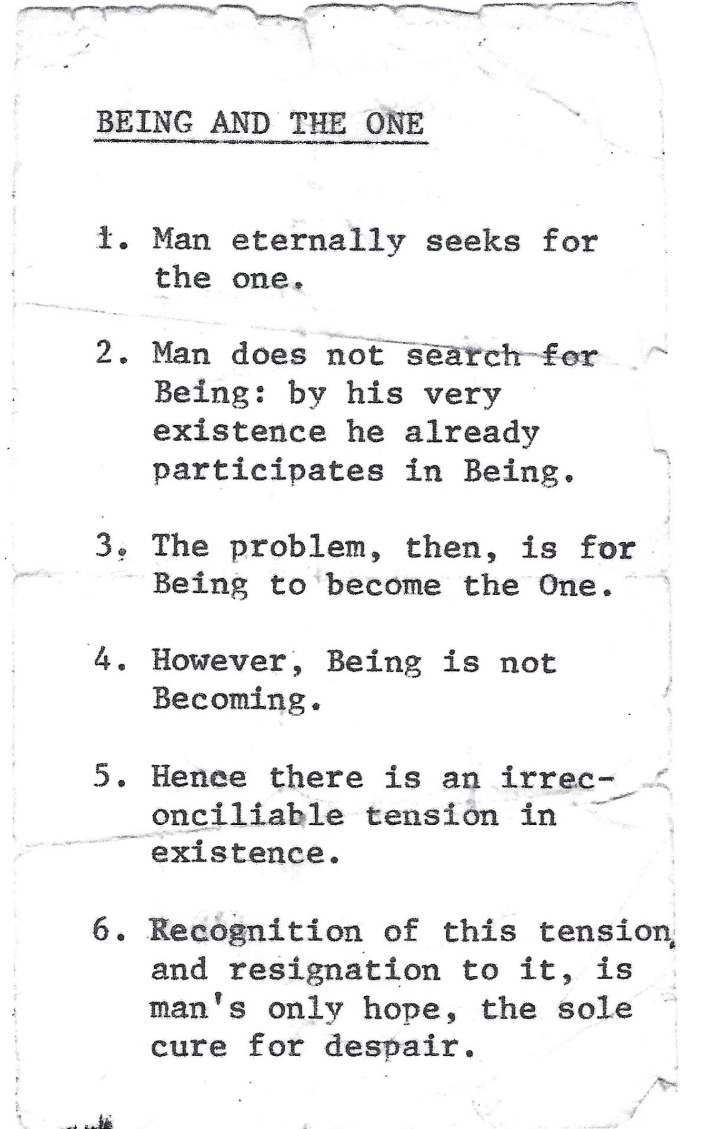
I lectured on those propositions for three-quarters of an hour, somehow. At the end one student excitedly asked me where he could learn more; another one said as he left, “Thank you; I never understood Lévi-Strauss till today.” And I never knew whether he was having me on.
I know that brand of jeans. Do you have other funny classroom stories?
Another anecdote: when the University of Toronto gave David Onley, the former Lieutenant Governor of Ontario, an honorary degree, I was invited to the dinner following at the president’s house. Onley made gracious remarks and then told a story of being in my class when he was an undergraduate. I was explaining the difference between deductive and inductive reasoning, and instead of being content with Bertrand Russell’s example of the latter—the hand that feeds the chicken wrings its neck—I pointed out the expectation that chalk, if applied to a blackboard, will make a mark on the board. But what kind of guarantee do we have that it won’t explode? I raised my hand with a piece of chalk poised to strike the board. Whereupon a voice from the back of the room cried, “Don’t do it!”
I didn’t remember the voice, but David Onley did, almost four decades later. You never know what your students will retain. I suppose it was a good lesson about reasoning for future Lieutenant Governors to learn.
A few moments ago, you mentioned that you want conversations in your classroom to go in both directions. What have you learned about prodding or provoking students who are not inclined to participate?
I’m fortunate to teach small seminars, with lots of conversation. Everyone has to make a presentation, which gets the reluctant to hear their own voice. I reserve 10% of the grade for participation, but warn that taking up too much air space won’t impress me. Two years ago half my class were voluble, so one day I forbade them to speak for the first hour so that others could participate. They were sitting on their hands, desperately trying to keep quiet. But it worked.
I remember you once said that your favourite three philosophers were Plato’s Socrates, Augustine, and Pascal. Does the ranking still hold?
My ranked order would be by the amount of time I’ve spent with each of them: so Plato by a long shot. Augustine’s life, passions, and self-awareness intrigue me. His approach to philosophy—faith seeking understanding—I think is entirely right. Philosophy doesn’t construct the world out of its own head; it tries to understand the deliverances of imagination and experience as well as reason. Pascal I must have mentioned out of a desire to spend more time with him, but I’m taken with the compacted, understated glimpses one gets in those pensées, rather than a comprehensive philosophical system. Philosophy is the love of wisdom, and wisdom can be found in pithy statements of glimpses of the truth of things, to be unpacked in a community of seekers.
Of course, Pascal never finished his Pensées, so many of the pithy statements were pithy by accident. Some of them would have been filled out had Pascal lived to complete his book. Another French thinker from that scene, La Rochefoucauld, wrote pithy statements on purpose. He originally drafted propositions in his Maxims for public consideration at salons. For La Rochefoucauld, an effective maxim attained a sort of simplicity and universality, and I guess that one goal in discussion at the salons was, to borrow your words, to unpack the proposed truths in a community of seekers. Your earlier remarks about philosophy as a process, rather than a product, are coming to mind now. These days, is there a kind of writing by philosophers that invites a community-based interrogation of ideas?
Community-based interrogation of ideas goes on in very different kinds of communities. Professional philosophers talk among themselves, but they usually interrogate each other’s ideas. Ideas of general concern to a good human life and society don’t belong to philosophers alone; other professions like political theory, sociology, economics—well, the whole gamut of disciplines—have their contributions. So do the arts, maybe especially so. While we don’t have salons these days, we have think tanks and research groups and less formal concatenations of talkers-among-themselves.
In my world, the philosopher would be one of the participants in these discussions, doing a lot of listening, but also testing the strength of evidence for claims, and probing the ethical implications of proposals.
Compared to when you started out, is it easier for a philosopher to wander from home, so to speak, and join conversations with non-philosophers?
In some ways, Anglo-American philosophy in the last quarter of the 20th century started to leave home in a way, by developing a whole range of ‘philosophy of x’s. (I recall a crusty philosopher asking, when a course proposal for philosophy of biology was before the Department, “What’s next? Philosophy of forestry?”) But this was often arms-length listening in to what biologists or historians or whoever was on about in the next room. It wasn’t sitting with the practitioners who were trying to solve a problem or make policy. That is to be expected, given the disciplinary structure of the academy: you have license to speak or write about a discipline’s concerns if you have the requisite credentials. However, the complexity of our world means that the knots of many problems can’t be untangled with just one or two disciplinary tools. Philosophers should be lending their tools to the task.
I don’t want to argue that the only legitimate philosophical activity is engaged or public philosophy. The perennial philosophical perplexities need to be studied; the tribe of professional philosophers should have their rituals. But I do want to hold that engaged philosophy is crucial to the full human enterprise, and that philosophical engagement can in fact illumine and challenge the professional tribal rituals and certainties.
You’ve served in many administrative roles, inside but also outside of the university—an example of the latter is your role as the chair of the Ontario Universities Council on Quality Assurance, an organization responsible for assuring the quality of any degrees or graduate diplomas in the Province. Was that work part of what led you to write public philosophy about education?
Certainly my philosophical interest in academic freedom and integrity arose from my non-philosophical activity ‘outside’ the guild of philosophers. That included administrative responsibilities for academic policy and faculty relations, university governance, and almost two decades working in quality assurance both in Ontario and Alberta (which I still do occasionally). You can’t do all that without scratching your head about issues in public philosophy. Much of that came out in Course Correction but, not long ago, I also read a paper on freedom of expression for the board and senate at the University of Waterloo.
You don’t teach writing, but you read and react to and also grade student writing. Do you have any observations about how student writing has changed over the years?
Comparing student writing over my career is difficult, because I began teaching undergraduates at the Scarborough campus, where few students were philosophy majors. Most in my courses were looking for a humanities credit. So, the writing was not always strong. One student I had was not a fluent writer, and when he asked for a recommendation to graduate school, I wrote that he could do an M.A. but I wasn’t sure about the Ph.D.
I wasn’t wrong about his writing at the time. But I was wrong in thinking he couldn’t improve. He worked at it, did a Ph.D., got a position at U of T, wrote many books, and rose through the administrative ranks to a Principal and Vice-President.
The students I have taught in the last decade are all academically talented; they have to make a special application to be in the Vic One program, and we are able to select fine candidates. That said, their formal education in grammar is appallingly absent. Even when they write well, they don’t know what a subordinate clause is; they don’t even know how to use a semi-colon. I spend some time with them on respect for language. In spite of that, some of them are impressive essayists.
What sort of writing advice have you often given your students? Have you sometimes shared pithy bits of writing guidance?
My advice over the years has been to write for an intelligent sibling rather than for me. “If you say something simple, you might say something profound. If you try to be profound, you will just sound silly.”
The other advice, for more sustained writing, is to start with a problem that makes your reader worried. Then relieve their worry by the end of the piece. (Is that letting the fly out of the fly-bottle, asks Wittgenstein?)
What have you learned about writing by teaching?
That they are different exercises. Teaching requires you to attend to the look in the eyes. If they glaze over, or wander, you need to pull your students back. They need to interrogate you, as much as you interrogate them. Effective teachers actually know their students.
Most philosophical writing is in the essay rather than letter form, where you imagine your audience but have no direct relationship with them. As I’ve mentioned, much of my writing is scratching itches I have, in the hope that others have similar itches. But teaching should help one imagine the likely interrogations of your prose by a likely reader, and to address them.
You enjoy conversation, but I’ve also had the sense that the arts—music and painting, especially—are important to you. How has appreciation for art connected with your work?
If you are a philosopher interested in Plato and in religion, you develop a respect for what neat, precise language cannot do. Aristotle claims that philosophy is the satisfaction of curiosity, answering different ‘why’ questions. I took a course in Aristotle with George Edison; the one thing I remember was his pithy summary of the difference between Aristotle and Plato. Aristotle asks, “Why are things the way they are?” Plato asks, “Are things the way they are?” For a Platonist, philosophy is a quest, stopping at the edge of wonder. The arts, in particular music and poetry, point where reason is impotent.
You’ve spent time thinking about silence. Philosophers talk and write, and talk and write some more, but they might not be trained to know when to stop. What have you learned about knowing when to be silent?
The simplest and most famous statement is of course Wittgenstein’s “Wovon man nicht sprechen kann, darüber muss man schweigen.” “Whereof one cannot speak, thereof one must be silent.” The trouble is that we want to keep speaking, to fill the abhorrent vacuum of not-knowing. The trick is, I think, to use the right kind of language—poetry, metaphor, analogy—when the kind of knowledge that philosophers like to trade in runs out.
Your theme about the limits of language and the power of art to pick up where language leaves off is striking. I’ve noticed this in your writing in a few places. When did you first arrive at it?
I can remember sitting in my rooms at St. John’s College Cambridge in 1982, trying to get the words right as I put down thoughts on philosophical issues I was addressing to Paul—or more accurately, to what Paul wrote in his first letter to the Corinthians. I’d often go off to Evensong at 6:30 pm, where the liturgy took me, through elevated language and music sung by one of the best chapel choirs in the world, to the place where my struggles could relax. I express this elsewhere as giving over, not giving up. Human experience is expressed in more than words—in song and gesture, rhyme and rhythm.
Could you say more about giving over, not giving up?
Giving up is walking away from the struggle. Giving over is staying with it but ceasing to struggle.
There’s something here I’d like to try to understand better. Does the act of what you call giving over inevitably lead back to language? Consider that when we immerse ourselves in art, or in nature for that matter, we often find ourselves plunged back into the realm of language. Our experience of art is facilitated by words; we develop interpretations and consensus about art through communication with others; and so on. Is there a kind of phase transition between giving over and needing language to make sense of the relevant experience? If so, doesn’t that mean that we are stuck with words in a situation where words have already hit a wall? After all, I thought the natural moment for giving over is when words have run out.
You’ve made an important observation about language and giving over to silence. It’s not that we can do without words; it’s that we can’t do enough with them. The experiences I have in mind are those where words or language (music may work as a language here) point beyond themselves. But we need them to do the pointing.
Here’s an example. One of my favourite poems is G. M. Hopkins’s “Spring and Fall”. The poem opens: “Margaret, are you grieving / Over Goldengrove unleaving?” The poet uses the extravagance of words to say what Margaret can’t articulate, about her experience of leaves falling—but he engenders that experience in us too. And at least for some of us, that experience means handing over our very being to an ending we can’t articulate ourselves.
If you prefer a mundane example, read the words that wine connoisseurs write about a vintage red. In the end, you just have to give yourself over to the taste.
So I’m not sure that we are driven back to language to make sense of some of these experiences. Rather, the language circles round, dancing, trying to get it right, always saying yes, but… Back to faith: that’s what liturgy is, for me as an Anglican.
Well, I’m neither an Anglican nor a wine drinker, but I’m curious to know what you’d say about faith and the work you’ve done in your career. Here I mean faith in a broad sense—not just religious faith but also faith in the value of ideas and education, and faith in the future of important institutions, such as the university. How is faith connected to your work?
That is a very large question, and I’m not going to write a paper about it here!
I’ve been thinking recently that I’d rather talk about commitments rather than ‘faith’. ‘Faith’ gets contrasted to reason, evidence, facts. If you take something ‘on faith’ when you don’t have proof, it’s easy to slide into a view of faith as believing in spite of evidence, closing your eyes to what might challenge your belief. That gives ‘faith’ a bad name.
Think, though, about commitments. A commitment is the taking up of a stance and a practice, regarding the world and others in a certain way and behaving accordingly. We make commitments all the time, and many of those commitments do not arise from evidence or reason.
Some commitments are fundamental, such as commitments to be reasonable, or to treat others as ends rather than means. Those properly basic beliefs that the Reformed epistemologists talk about entail commitments: that there is an external world, or other minds, is a stance on reality and persons from which our actions follow.
Some commitments, to trust X or to make promises to Y, are reasonable, and some are plain stupid. These are stances on future states of affairs that require practices of me, not just beliefs. Since I can’t fully know the future, such commitments need a bit of a jump, if not a Kierkegaardian leap. When it comes to trusting another person, there is always something in them inaccessible to me. Respect for their integrity means that they control the limits of my knowledge about them. Love knows when to stop asking questions.
I’m interested in commitments to institutions and forms of life. To belong to the university is to make (sometimes implicit) promises to act in certain ways, to be governed by certain rules and policies, to meet certain expectations. Plato wasn’t wrong to have Socrates speak in the Symposium of love for institutions – which means not just respect, but also a willingness to correct and enhance its workings.
Commitment to the philosophical form of life means a stance of interrogation towards the world and our understanding of it. But it also requires a commitment not to make certain what resists certainty. I have to respect the boundaries and the inadequacy of language. When I do that, I often turn to music, the arts, nature. That can disclose mystery. Religious faith, for me, is a commitment not so much to believe certain claims as to open myself up to the experience of grace, the divine, God. And then to commit myself to divine care. That’s how, for me, philosophy is a propaedeutic to ‘faith’. That’s not the only role for philosophy within the religious form of life; the articulations of religion (for me the Gospels and early Christian writings in particular) need to be interrogated and worked out in the changing circumstances of our world.
Of course you don’t need to be a philosopher to grasp all this. The French composer Jehan Alain wrote at the top of the score of his organ piece Litanies, written in August 1937 after the death of his sister: “When the Christian soul can find no new words to beg for the mercy of God in distress, it endlessly repeats the same invocation with a vehement faith. Human reason reaches its limit. Only faith continues its ascent.”
Enough. Time to listen, not write.
Notes
-
Did Long find out?
Not to my knowledge. He only met once with the two of us who were teaching sections of the course and then left us to our own devices. I believe the other person was Wayne Sumner, who later became chair of the department. ↑
- Richard Taylor, 1963, Metaphysics (Englewood Cliffs, New Jersey: Prentice-Hall), p. 2. ↑
-
That is quite a story about Taylor and the dog. I haven’t had the pleasure to attend a thesis defence like that. Do you have other stories from defences?
In the late 70’s I was chair of a Ph.D. oral for a student in the centre for the study of drama. The thesis was on a minor figure, a dramaturge in England. The committee was not overwhelmed, and the defence was limp. Marshall McLuhan was an examiner. I had to give each examiner a chance to speak about the quality of the work and the defence. When it was his turn, McLuhan simply said something like, “a lightweight subject, a balsa wood thesis. It fits.”—and he voted in favour. I distinctly recall the balsa wood image. ↑
-
Here’s a question that might seem a bit odd. Would you say that Bill Mason was a Canadian philosopher?
I’d put Bill in with the literary figures Northrop Frye and Margaret Atwood who explored the ideas of North and Wilderness as built into Canadian identity. But Bill did this visually—in the film Death of a Legend, he worked at replacing fear with respect for the wild in the wolf. It depends on what you think of philosophy. Does it construct a world, or does it make self-conscious the business of world-constructing?
Right. I suppose I see some of Mason’s work—not just the art and film, but also the narrative bits in his films—as an attempt to reconfigure certain worlds. He shows the viewer how his thinking evolved. For example, early on, Mason was inspired by the Voyageurs; he read about their journeys across water and land, and he spent time in the north retracing their strokes and steps. They were heroes to him. But then he came to understand that the Voyageurs were part of a disastrous colonial project and he adjusted his way of thinking about them and their legacy. They were tough guys while running those rivers, but their project was full of brutality and they brought suffering to Indigenous people. His film Waterwalker raises that sort of theme and notes how his own spiritual thinking deepened and expanded when he learned about Indigenous traditions. Anyhow, my sense is that Mason’s work of reconsidering, revising, and revisiting was philosophical, in some sense. And I agree with you that there’s a strong literary component, too.
When did you encounter Mason’s films?
I seem to remember some teachers in elementary school showing old National Film Board titles on rainy days when we couldn’t go outside for recess, but also perhaps in connection with some class or other. I don’t know. I might have borrowed some of the films from the local library on VHS. Later, after the internet arrived, I found his films online.
You know much more of Bill’s work than my overworked memory had recalled. So I will grant you this: that calling into question a dominant view of the world is indeed a philosophical exercise. I of all people should affirm that. Philosophizing is done in at least two modes: the construction and deconstruction of particular arguments for some belief properly called philosophical, and the development of a way or ways of looking at the world. A developed view is a philosophy; but we are prodded by non-professional philosophers to question aspects of our inherited view or views. Artists are especially good at that. Why not call them gadflies in a long philosophical tradition?
That seems right. I get the sense that Bill Mason would have thought of himself as a gadfly of sorts. He tried to use his films to challenge our comfortable acceptance of destructive practices and ideas. In my mind, he’s a bit like the conservationist Rachel Carson and the anarchist writer Edward Abbey, though Mason used his art and storytelling—not argumentative writing or essays—to raise an alarm about the environment and our ways of life. Would you say Mason was a gadfly? You knew him—what was he like?
A gadfly? Well, in the Socratic sense a gadfly is annoying, and I don’t think that word fits Bill Mason. His work celebrates the created world, and thereby challenges us to reflect on what we’ve done with it.
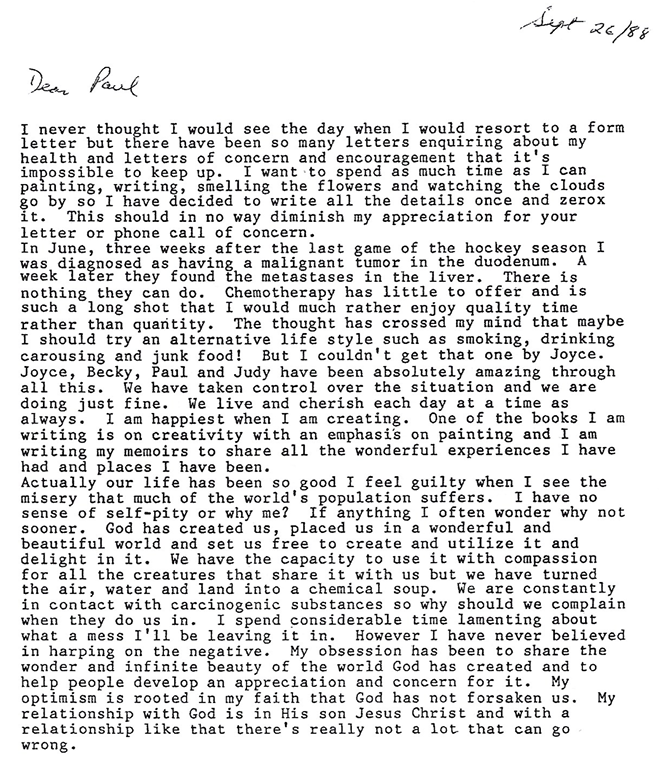
I knew Bill through his good friend Wilber Sutherland, with whom he made the film Wilderness Treasure. I didn’t see him often, but I clearly recall his gentle, passionate enthusiasm and the wonder at the world reflected in his clear eyes—which I’m sure were blue, though I can’t verify that. When I learned he had terminal cancer in 1988 I wrote him something I don’t have a copy of now.
Did he write back?
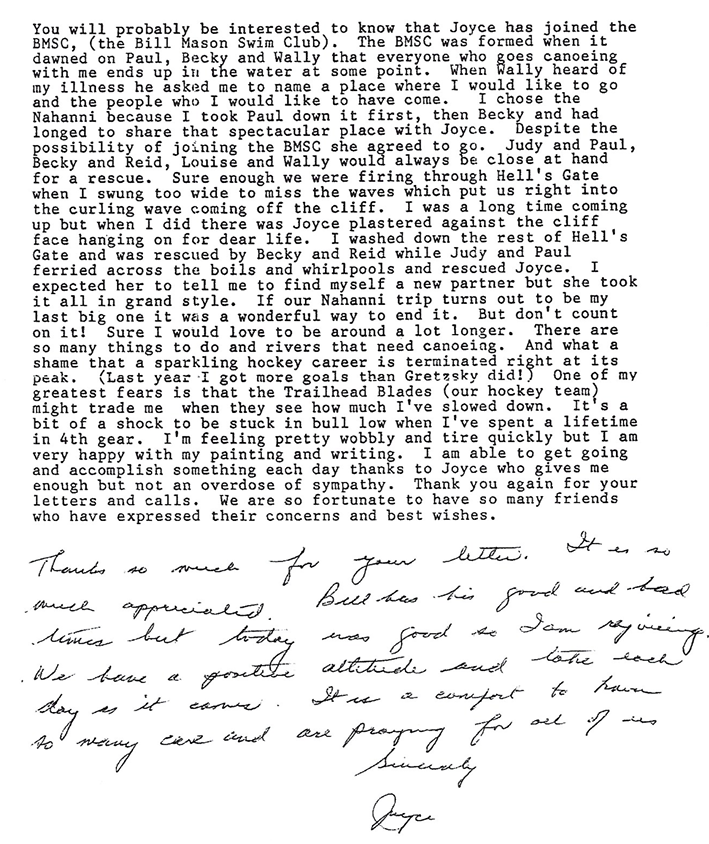
Bill was too ill to reply personally to the letters he received, but he did manage a form letter, full of his personality, and which his wife Joyce sent me with a handwritten note. Here it is:
-
Professional philosophy in many quarters of the English-speaking world tends to have a secular self-image. Did you ever feel like an outsider as a philosopher with a philosophical interest in religion?
Of course, a theist philosopher often feels that colleagues generously tolerate his or her aberrant beliefs. And it’s often assumed that philosophers are all secular. In my administrative roles at U of T I got to know lots of people, one of whom was the Chancellor, a former provincial premier. He came to my book launch for Paul and Religion and remarked with a smile, “Gooch, you’re the only philosopher I know who believes in God!” However, his comparison group is small. U of T’s college system includes St. Michael’s College, with some fine Catholic philosophers. And early in my career, American philosophers like Alvin Plantinga, Nick Wolterstorff, and William Alston began the Society of Christian Philosophers—in 1978 I read a paper at its first meeting, in Cincinnati. Canadian philosophers like Terry Penelhum and Charles Taylor belie the popular assumption. ↑
-
Do you have a copy of the poem?
I found it in my office:
“AS I SAID TO SOCRATES THE OTHER DAY…”
Yes, that’s what I think it is.
Clearly.
Well, if you want to know about that, yes, that’s true.
No.
I should say not.
Of course.
Perhaps.
Perhaps, again.
If you make me choose, yes.
Sometimes, I think.
Alright, on all occasions.
No, I hadn’t seen…
Well, now that you point it out, I guess not.
No, not at all.
I guess I didn’t.
It would be pretty difficult to think that now.
No.
I’m not sure I could.
Well, thank you very much, but…
Really, I’d better not keep him waiting.
Goodbye.